Qualification Before Deployment.
A second-life battery should become a measured asset—not an assumption.
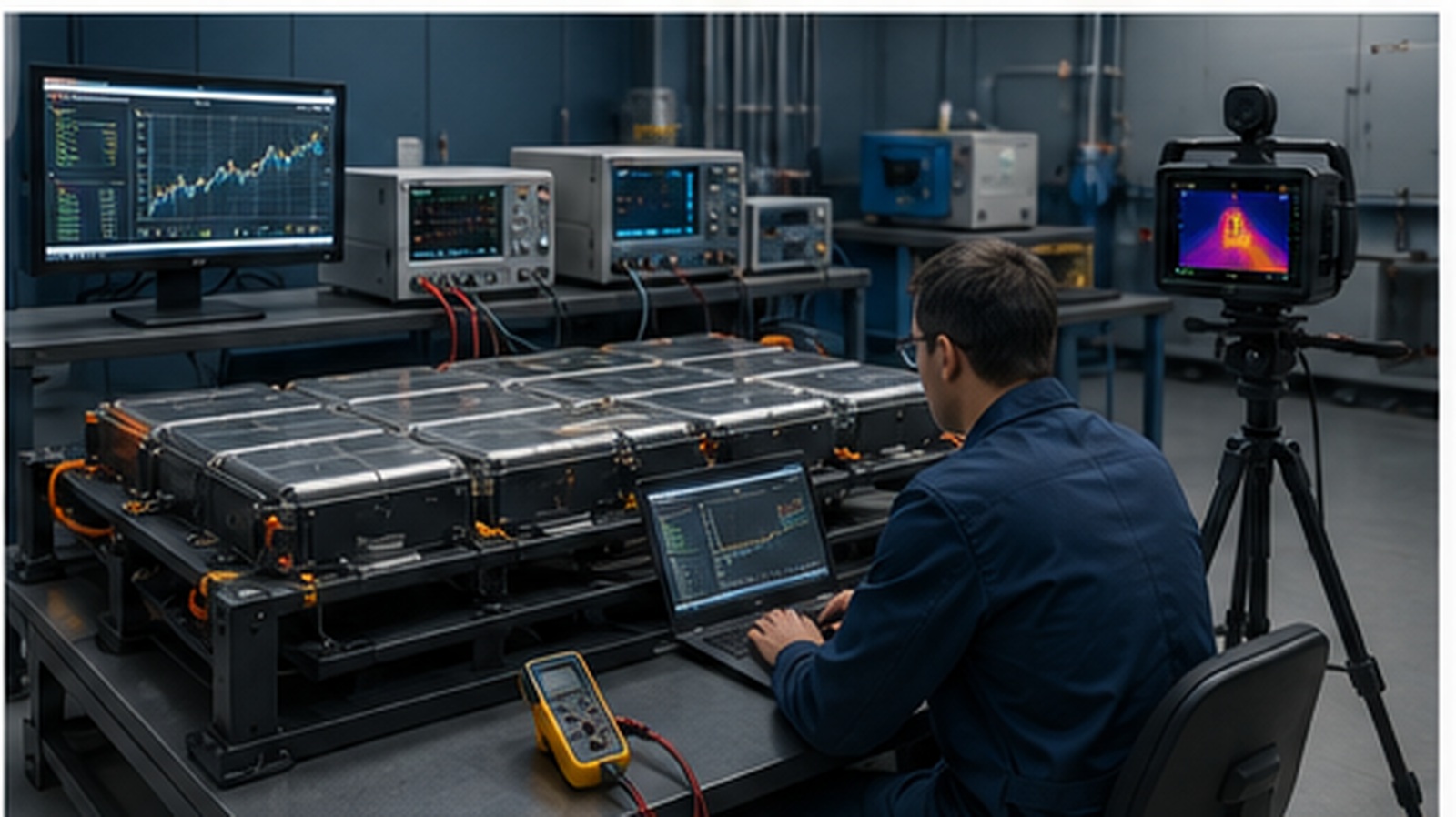
Every second-life battery begins with evaluation. Conceptual rendering — not an actual IntactPack facility.
A retired EV battery should not enter stationary service simply because it can still charge and discharge.
IntactPack is developing a structured battery-admission process intended to determine whether a candidate battery is suitable for continued use, requires restricted operation, or should proceed directly to recycling.
A Structured, Multi-Stage Admission Process
Descriptions below are intentionally high level. Exact test procedures and pass/fail thresholds are proprietary.
Identity & Provenance
Battery family, configuration, available source information, and relevant history where available.
Physical Condition
Evidence of unacceptable structural damage, leakage, water exposure, corrosion, connector damage, or abnormal enclosure condition.
Electrical Integrity
Basic high-voltage and battery-system integrity relevant to safe controlled testing and deployment.
Battery Health
Remaining energy capability and degradation indicators.
Thermal Behavior
Temperature response and thermal consistency during controlled evaluation.
Battery Management Information
Available OEM battery-management information, warnings, and reported faults.
Controlled Performance
Observed charging and discharging behavior under defined test conditions.
Every Qualified Battery Receives an Operating Identity
Instead of treating every battery with the same original label as equivalent, IntactPack is developing a process that can associate each qualified asset with information such as:
Measured Usable Energy
Health Classification
Approved Operating Category
Operating Limits
Qualification Record
Re-Evaluation Schedule
Exact criteria remain proprietary and subject to engineering validation.
A Lifecycle Record for Every Qualified Asset
Each admitted battery can be associated with a digital lifecycle record that follows the asset through its full second-life journey.
The goal is improved traceability, responsible lifecycle management, and a stronger data foundation for second-life battery operation.
Where Qualified Batteries Go Next
Qualified assets become distributed energy resources — supporting resilience, renewables, and the evolving grid.
Explore Grid & Resilience